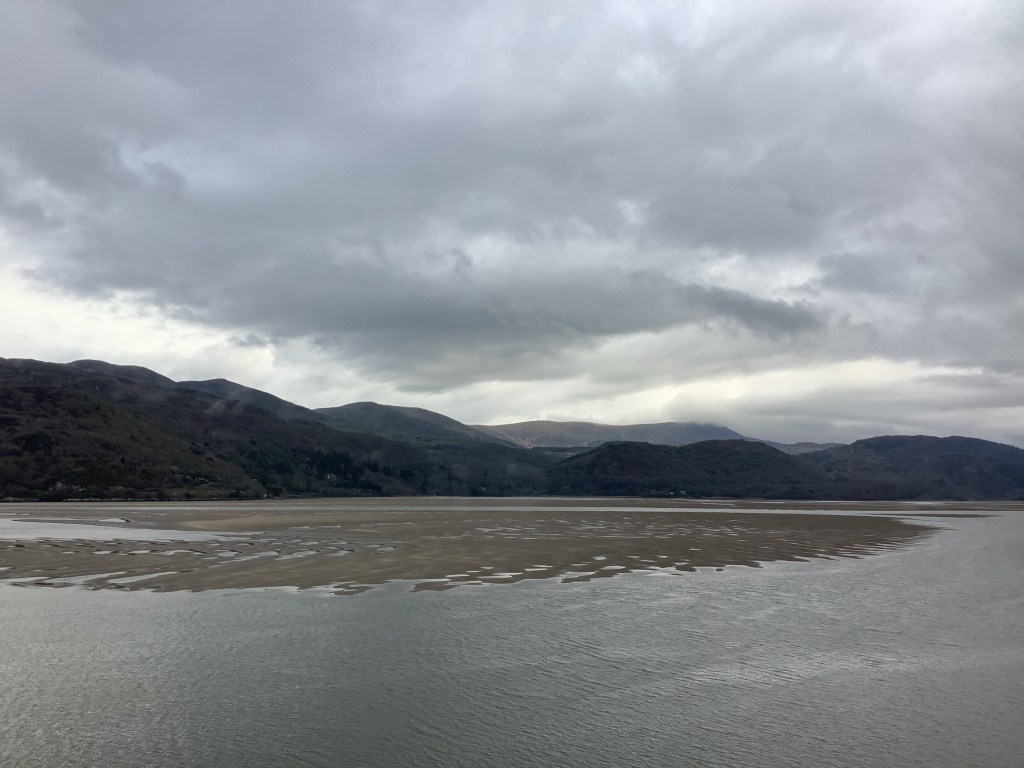
As I write this, I enter the second half of my residency on the Mawddach Estuary. Tempus fugit, tomorrow not only points firmly towards the end, but is also the start of May – how can that be?

Unlike previous residencies, this one has not yielded much visual matter, so I have not posted much on social media accounts, or here.

Writing is a different sort of practice: rich, compelling, frustrating, iterative, joyful, and very, very hard. Wait – that’s exactly like the printmaking!

That is enough gazing, I think. By the end of my time here, I hope to have:

> 6 drafts of long-form blog posts/articles about sustainable practice, to be refined and then released slowly over the coming months;
> completed 9 of the exercises from Natalia Ilyin’s Writing for the Design Mind;
> 4 watercolour monotype plates for printing;
> 4-6 small enviromount dry point plates for printing;
> collected plant matter from the surround area to make one small and one large soft ground plate, to add to my library

Unusually for me, I didn’t set these goals at the beginning. The practice of writing, not of emails and lists, but thoughtfully and carefully, is so new. It was only this morning, while I was getting ready to write again, that I felt ready to put to paper some goals for the rest of my time here.

I wish the weather would turn. We’ve had nothing but sunshine in Wales and it is beginning to weaken my focus, resolve and discipline.

The allures of a residency in a remote-ish part of the country are the solitude, the excuse of not having a very good signal, and the distance between myself and my studio life. The ability to put reading and writing front and centre feels both luxurious and stressful.

Unlike previous residencies, I am not tethered to a teaching or process schedule, or the need to make work. I miss the tethers already.

I have now read the books and articles I’ve set out to read for this journey. Today begins a series of exercises outlined in ‘Writing for the Design Mind’ by Natalia Ilyin. This book came highly recommended to me by several writers, academics and artists: a useful and practical guide designed to help those in visual practices to articulate better.

As well as writing about sustainable, inclusive printmaking practices, I will be setting aside time each day to complete an exercise, moving through the book step by step. The goal is two-fold: develop my writing style so that I can communicate better, and develop a daily habit of conscious, thoughtful writing that I hope will continue when I return to London. I feel optimistic about the former, less so of the latter.

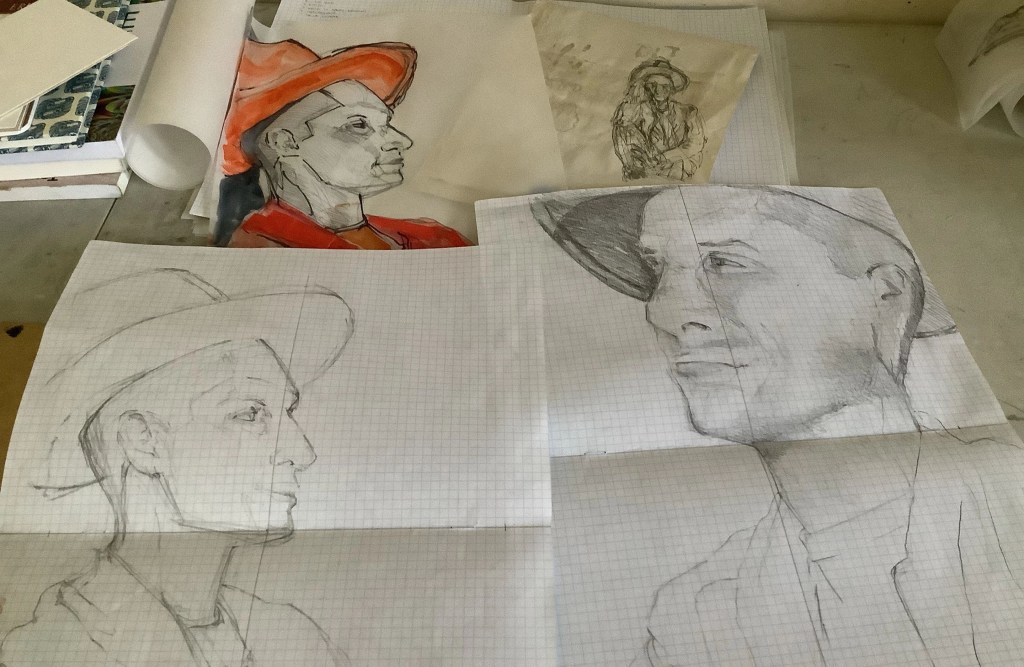
I don’t ‘do’ life drawing. Haven’t in nearly 20 years. The thought of it brings up flashbacks of anxiety, tension, art-school trauma. And yet, somehow, being here, in this landscape, this happened.

From last night’s Draw Brighton session.

Jake Spicer, one half of the Mawddach Residency team, led an online life drawing class last night as part of the Draw Brighton programme. Part impulse, part social pressure, I put pencil to paper… and enjoyed it much more than I thought I would.

Just before the session I even warned Marigold, who is here on residency as well, that I might not share what I make. And yet, here I am, sharing with you all, because when you climb a mental mountain, you must shout from the top.

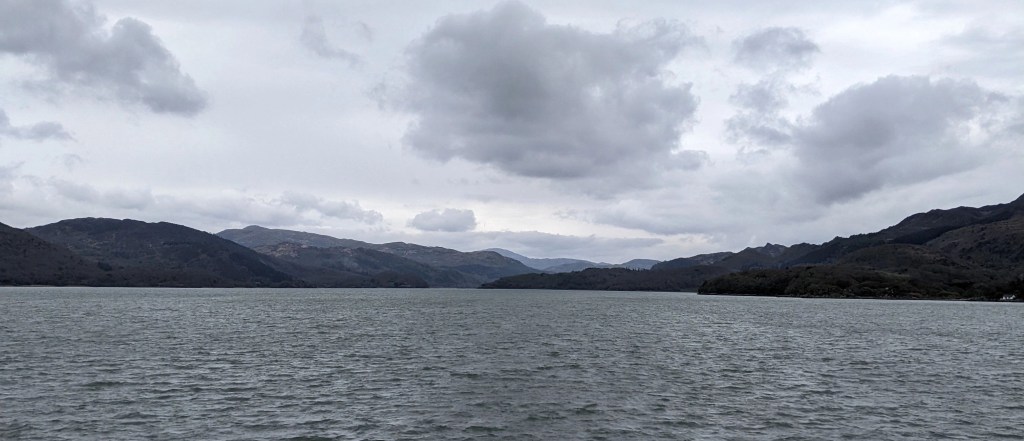
View from my room on the Mawddach Residency, Wales

It’s the first Monday of my two-week residency in the Mawddach Estuary in Wales. I arrived in Barmouth on Thursday, walked the coast and hills for a few days, and then moved over on Saturday.

Why am I here? Ostensibly, to read and write and think about sustainable practice and inclusivity in printmaking practice. Between the reading, walking and drawing, however, I suppose I’m here to make a decision, or at least, a steer.

I’m privileged to be at a crossroads, an intersection where artist, technician, and academic meet, but it’s beginning to feel as though I’m running out of time. Whether that is from climate anxiety, changes to my own mind and body as time passes, or the rapidly shifting landscape of higher education, time feels like it is slipping away and my personal resources are limited.

I know there are people, amazing people and printmakers, who can do it all – teach rigorously, write thoughtfully, and make meaningfully, I now know that isn’t me.

When I was working in HE, I gave it everything and made nothing.

When I teach or tech now, if I’m not completely prepared, I cannot focus on anything else.

When I’m making work, I dream of colours, compositions, process.

And when I was reading about inclusive arts education and critical race theory yesterday, all day, I was so absorbed I didn’t notice someone was taking photographs of me until she mentioned it at dinner. (This was fine, by the way, I’m not having a go at her!)

Today another book awaits, more drawing, and a walk over a hill.

Before I start writing about practice, I’m just going to state here that I know the best solution for the environment alone is to not make, consume, or do anything at all. That would be true of any consumption – clothing, food, technology, etc.

That isn’t what I’m try to do, I’m not going to go to ‘zero’ because all of life’s experiences require consumption of some kind. Consider everything that is required to go for a walk: shoes, clothing, time, space, access, and a place from which to go and return.

Rather, I am trying to align my practice to a particular definition of sustainability, as set out by the United Nations Brundtland Commission in 1987:

“meeting the needs of the present without compromising the ability of future generations to meet their own needs.”

and to go one step further – to print in the present, and to support the ability of those who wish to print in the future, through practice sharing, research, and in some cases, documenting when it goes wrong so others can learn and improve on my errors.

It sounds more grand and noble than it really is. I take personal pleasure in the research (nerd alert). I find satisfaction in sourcing economic, sustainable materials and making them last. I take comfort that a long day in the studio does not result in feeling light-headed from petroleum distilled solvents, and in knowing that I and others are less likely to suffer long term adverse effects of exposure to hazardous materials. And I am interested in how this research effects the work itself, aesthetically in surface and mark making, and subject matter.

Bottom line, the goal is to make prints forever, not to conclude that printmaking should simply stop.

It was over before it began, and everyone was lovely.

I’ve written this entry nearly a year after the residency, because it’s taken me that long to digest everything. In addition to my research question about the viability of VCA in stone lithographic processes, I had come to AGALAB to make and show work, to share with others my experiences and the results of my efforts.

In 2019, I had a solo exhibition in De Bouwput Galerie at the end of my residency. ‘Free to a good home’ was about sharing my experimentations in lower toxicity etching, and inviting the members of the studio and public to participate in mark making. Everyone was able to ‘adopt’ a pigeon artwork and take it home, for free. I felt this was the best way to say ‘thank you’ to a community that embraced me with open arms even though I was only there for a month.

It was an amazing experience, people drawing, painting, directly on top of etchings, participating in a group creative action. There was a brief moment of hesitancy, but everyone got stuck in, and the night was, for me, a bit of community magic.

The gallery was not available this visit, nor did I feel my final work would be at any sort of ‘hanging’ stage. I did, however, want to say ‘thank you’ again, so ‘Free to a good home II’ was born, an in-studio final event where everyone could be together. This was especially poignant after two and a half years of everyone being apart.

For one night only, members of the wider studio, members of the public, friends, colleagues, and staff from the print workshop, gathered to draw, animate, drink, and share stories over a pile of lithographic discards. I showed everything, the good, bad, and disappeared, and told the story of sponges, gum, and VCA, and everyone was kind enough to listen.

I was touched by how many people who had visited my exhibition in 2019, returned for a second round of pigeon prints. And I was thrilled to see people participating with gusto. I still have some of their interactions, archived in my London studio. I hardly ever look at my own prints from this period, but the interactions I had with others, stay with me every day.

To read an interview from my time in Amsterdam, go to the AGALAB website here.

Note: I was very lucky to be able to ask a research question and afford a negative outcome. Thanks to my grant from Arts Council England, I was able to try something, learn, and reflect, and then decide against adopting VCA into my lithographic studio practice.

In the end, I did get the VCA to work, to an extent, and managed two, medium, black and white lithographs in small runs. One of these has been accepted into this year’s RE International Original Print Exhibition at Bankside Gallery, London.

I left notes and suggested instructions for future lithographers at AGALAB to follow, or ignore, and I even squeezed in a quick workshop with two interns – there is no better proof of learning than teaching.

… but I’ll never show that large print in public, except here, in the quiet space of my blog. All the other pigeons have been given away, and I have gone down an alternative route, but looking back, I’ll always be grateful for this opportunity to fail.

The Big Stone Conundrum.

I had lots of plans. I was going to try and make a CMYK lithograph of a dead pigeon, on the largest stone I could find.

Pigeons were, and continue to be, a source of research, visual exploration, and metaphor. I had been photographing dead pigeons whenever I came across one, which is more often than you might think, given how short my daily commute is.

In my mind I had it all planned out – deeply scored registration marks would make lining up a breeze; lightly graining the stone between colours, and then using counter etching to open up the stone to new drawing, while keeping remnants of the previous layer. It was going to be smoooth. Until it wasn’t.

Geowash-K, the VCA in use at AGALAB, is incredibly strong. Yes, it removes the drawing material, but horror of horrors, left too long, it also dissolves the fatty deposits on the stone! On a small to medium stone, printing in black, you can get away with it. I learned that moving quickly and using less VCA meant I could keep most of my image, and printing in black meant it wouldn’t have to be… super clean?

At this point, I wouldn’t recognise myself.

If, however, you were working on the largest stone available, measuring a full 70cm x 100cm, and you wanted to print a clean yellow… disaster ensued. To get the stone clean of drawing materials required more VCA and more time, which led to more of the fatty deposits dissolving and, in some cases, disappearing entirely. Yellow was both heartbreaking and exhausting. The drawing just disappeared. I know when I teach lithography, I say this is a possibility, just to prepare students… but I don’t really mean it.

Magenta and cyan were similar experiences. I persevered, despite the disaster image I was creating, because it would still be worth trying a deeply scored register, graining lightly between layers, working with a citric based counter etch. I’m pleased to say these things all worked, but the image was a disaster. I’ll post it here, but I’ll never show it in public, I’ve not signed any of them since returning from Amsterdam. They sit in a drawer, a reminder of what should have been.

“Do I even know anything about lithography?”

This second week at AGALAB certainly had me questioning my life choices. My first three stones failed. When I say failed, I mean inking, processing, and printing disasters.

It’s hard when this happens, not because of the time you spent graining and preparing, or even because the drawing is an original that you’ll have to attempt again. It’s hard because it doesn’t make any sense, and that’s part of the process. In every book about stone lithography will be a paragraph, chapter or section about failure. Sometimes it happens.

I chose to start with three small stones, and simple drawings – one plain crayon, one crayon with a gum resist, one tusche stick wash. I processed the stones as normal, with freshly made gum, nitric acid, and ultra fresh sponges bought especially for the trip. I even had fresh cheesecloths, or “kaasdoekjes” in the local dialect. And, in the spirit of sustainability, health and safety, and my research grant, I used Geowash-K as a direct replacement for solvents in the processing.

I poured a very small amount of VCA onto the surface of each gummed stone, struggling to dissolve the original drawings, but persevering through a high degree of sheer will. I buffed as much off as I could, used some noir a monter to prime the images, hit the stones with a fresh wash of water, rolled up… and everything filled in. All three stones. All filled in. But also.. the images didn’t quite come up either. WTF? So not only was there too much grease on the surface, there wasn’t enough grease in the image?! It was a nightmare. A slick of inky grease clung to the surface of the stones, but the images themselves did not roll up well.

I’m going to admit a failure of research at this point. I didn’t photograph or film the disasters. In a moment of embarrassment, shame, fear, I didn’t document, didn’t want to admit what happened.

I went into automatic problem solving mode. I mixed a strong anti-tint solution, using citric acid as the studio did not store phosphoric. I broke out my emergency felt pads, brought along as a last minute “just in case”, but never actually imagining I would use them. I descummed, two, three, four times, trying to at once roll up the image, but also prevent the non-image areas from greasing over. I was grateful for the cool autumnal weather, but alarmed by all the other users in the studio, who were gradually become aware of my despair.

Eventually, some sort of semblance of the original images inked up on the stones, the surrounding area a bomb site of felt pads, water, gummy fountain solution, anti-tint, and the saddest fresh ”dirty” sponge, loaded with loose ink particles and grease.

I talc’d, gummed, buffed, and went for a long cycle ride. I wouldn’t come back until evening. The next few days, I would print my disaster stones, unhappy with each other them, still greasing over, still requiring absurd amounts of anti-tint, all the while drawing on my Very Big Stone in fear of the processing ahead.

Aside: I was unlucky – my time at AGALAB coincided with the departure of their specialist technician in the traditional etching and lithography department, so I had no staff member to consult. My understanding was that few people had had much success with VCA and lithography anyway, and I came to AGALAB knowing this would be hard, but maybe not quite believing it.

My first week at AGALAB was humbling. I had been before, so it would be easy, right? Just slide back into my apron, and get to work, right? Wrong.

Brexit. I have a lot to say about Brexit, none of which is appropriate before the watershed, so I’ll just say this: shipping is not what it used to be. Rather than carry everything, I sent a box of nearly spent inks, a selection of paper offcuts, and some other materials to myself, ten days in advance of my arrival. I then spent the first two days in Amsterdam on the phone, weeping to customs, pleading for their release. I’ll leave it there.

It wasn’t the most auspicious start. Luckily, I had given myself over to two days of just graining, so I was able to wash away the bad, alone in the studio with a selection of stones. I chose the largest stone available, bigger than anything I could handle in my own studio, and some small and medium ones.

The best part of a live-in residency are the quiet hours. First thing in the morning, the light streams through the tall windows, the air is very still. On Sundays, when you have the whole studio to yourself, and you spread across every surface. That first weekend was bliss, just selecting and graining stones, checking out the press and rollers, preparing for the work to come.

Monday arrives and the workshop is filled with artists, technical staff, interns, and visitors. First drawings finished, and carefully, tentative, I began to process, having made a fresh gum solution, excited about processing with Geowash-K, excited about transitioning my stone lithography practice away from harmful traditional solvents.

The first three stones were complete failures.

I’m Ling, and I make prints. I also like looking at prints, handling prints, accessioning prints, printing with others, reading about printmaking. I like all of printmaking, screenprinting, etching, litho, but also monotypes, and digital prints. Each is a voice in a choir, an instrument in a band. I sure love teaching print. At least, I think I do. Or did. I can’t be sure now.

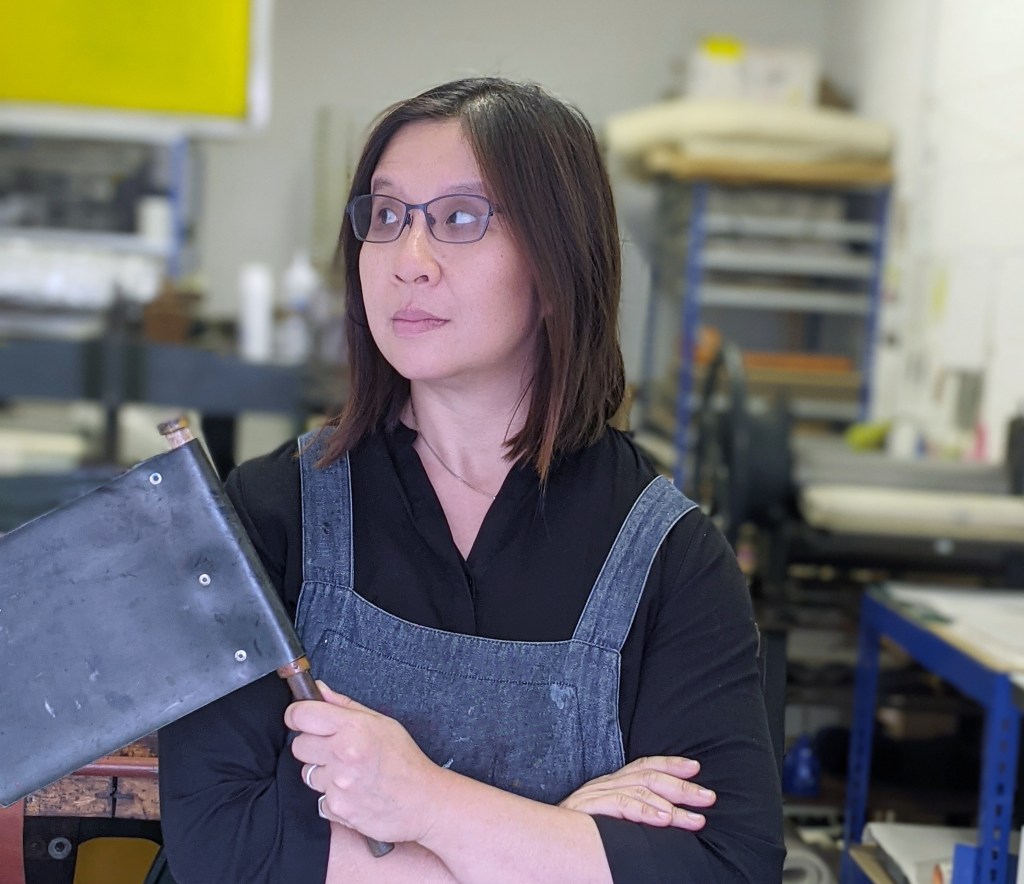
Photograph of myself in my studio, holding a litho fan and looking to one side
Me, in my studio in Woolwich.


I definitely love print, but it is a complex and difficult relationship. Once you poke your head up from the press and look at the world around you, lots of questions appear. Some of these are existential and timeless, the sorts of questions about examining life, not unique to art, or printmaking – why am I here, what am I doing, what’s it all for?

Other questions are more in this moment: is what I’m doing sustainable? Is what I’m doing causing harm? Is printmaking sustainable? Is it causing harm? If printmaking is so great, why isn’t everyone doing it? No, geniunely, why isn’t everyone doing it? Are there barriers built it, biases in its design, exclusions in its practice?

I’ve lost a lot of time confronting my practice in my mind, while I raced about with teaching and technician jobs. Sometimes the bigger questions take over the work, and the visual themes of empire, migration, and memory take a backseat, it’s a flaw I recognised in myself. There was never enough time or energy to make any changes, or to try and answer any questions.

So here I am, in 2021, following the strangest, saddest, angriest, weirdest, most eye-opening two years many of us will have experienced. I’ve left full-time teaching and technician life, for the life of an artist trying to answer questions. This is where I will be recording some of my findings.