A follow on from my previous post, and a new work without new plates.
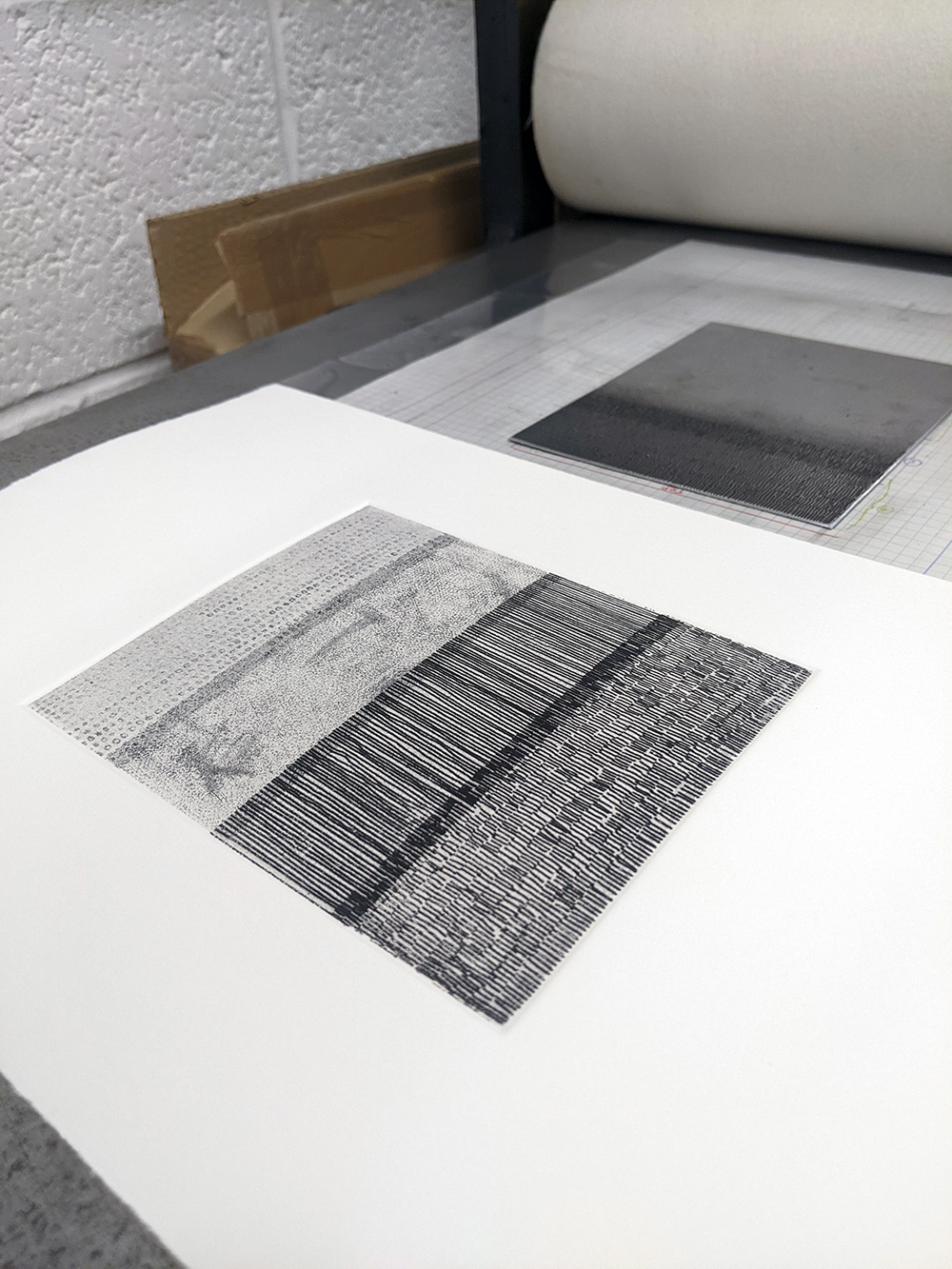
‘Four Part Breath’ is composed from the four steel plates of my ‘What breath remains‘ series. I use selective inking and tissue stencils, trapping and printing each layer from a different plate so the marks overlap.
I have had a meditation practice for most of my adult life. It is a way to find space in small places, a way to release yourself from anger or anxiety, or an overwhelming sense of happiness – that might seem strange, but I have found that joy can be as strong and awesome as grief. It is a way to come back to yourself, to focus on the present, your own body, your own breath.
It is also an essential part of my faith, but that is a topic for another day.
You make decisions to inhale, hold, exhale, hold. Over time, I have noticed that the way I print is also a breath practice. I hold my breath when place the paper down onto the plate, stone or block. I hold my breath each time I lift the paper away, and only exhale when I have released it. A sigh of relief when a print has gone well, a sharp intake of air when you notice an irreparable error.
In my quest to transform my practice into something I can sustain that is also sustainable, there have been quite a few highs and lows as well as a continuous hum of doubt. I have had to lean quite heavily on meditation to find quiet, especially in the beginning. More recently, however, I have begun to accept that the quest will not have a particular end, and that the practice is really a practice.
Edition of 10. Printed on offcuts of Hahnemuhle Etching from my Dockyard Diary series, with plates etched from the used mordant of the same work. Available now online.
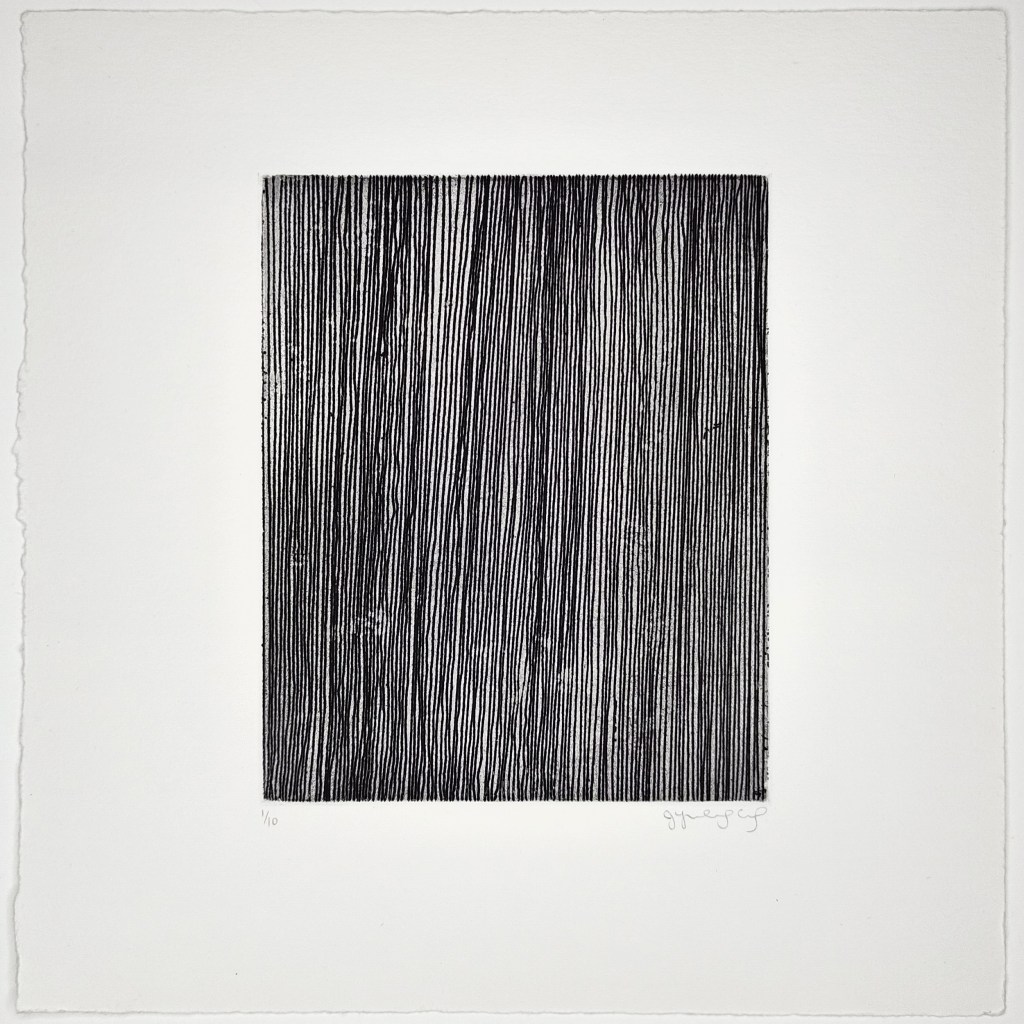
‘What breath remains, 4, 3, 2, 1’ Etching on paper, 2024. Edition of 10, available individually.
I begin 2024 with four small etchings. At the end of 2023, I finished processing and printing my ‘Dockyard Diary’ series, a body of work documenting plantlife allowed to run wild in Woolwich Dockyard, a former site of empire and British maritime power.
What remained to me was 6 litres of nearly spent, highly contaminated saline sulphate solution. Not only was the solution filled with copper sediment, there were trace amounts of plantlife, debris, and acrylic ground floating in the mix, making it unsuitable for any fine or accurate etching.
As I was getting ready to find scrap metal to neutralise the solution for disposal, I came across an old strip of discarded mild steel that I had degreased and put a hard ground on, back in 2019. I was curious to see how much ‘breath’ I still had in the mordant, so I drew these four plates, and placed them into the solution. They went in, in 24 hour intervals, so that the first plate ended up with a 96 hour etch, the second with a 72 hour etch, third with a 48 hour etch, and the fourth plate, a meagre 24 hour etch.
I was surprised by how much strength there remained, and ashamed that I had been about to neutralise and dispose of it. They are coarse, but in my mind, rather beautiful. These four plates are reminder to myself that the materials are precious, and to make the most of each breath.
As an aside, I have always had a meditation practice – I started when I was 19 and have never looked back. It is partly faith-based, but also a way of channeling energy, anxiety, and a long standing relationship with depression. Watching the plates in the bath, slowly using up the etchant, felt like a four-day meditation – when I was away from the studio, they remained in my mind like an anchor to practice.
These four plates have been printed in editions of 10, with a few multiplate compositions in the pipeline. They are available here.
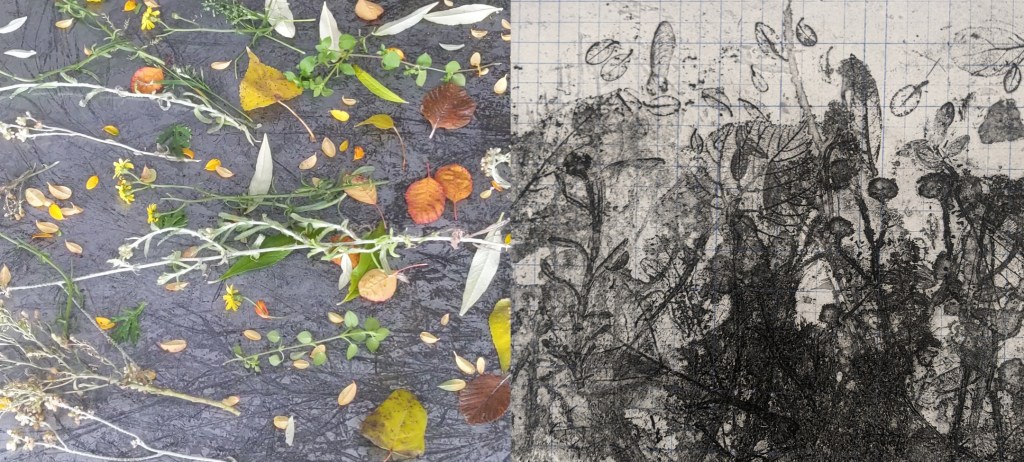
Left: Plant debris collected from the Thames Path, scattered on a steel plate. Right: Detail from Dockyard Diary: December
Final thoughts on 2023 – a crisis of faith: am I fooling myself to think I can move the meter?
I had the best intentions this year to write about my practice, and reflect on the sustainability of practicing sustainably, but I have been repeatedly rocked by a crisis of faith that has rendered me mute.
When I read about the climate disaster, the scale of our addiction to plastic, our rampant consumerism, the global human conflicts that consume huge amounts of energy and resource, and our not-so-slow march towards a completely different planet, I feel small, and my actions feel smaller. I realise the irony of being an artist with this concern – my practice is producing more and more goods into the world.
What is the point of my saving a few litres of water, reusing a single sheet of steel, or choosing fewer petroleum based products? I agree with many experts: big change must come from big organisations – businesses and government, entire populations.
I suppose it is a combination of faith and hope that pushes me to consider the small role I play within the printmaking, and wider art ecosystem. It is about survival. I believe that one day, in order to survive, we shall all have to live differently, so my practice is about making a head start. I don’t want print to fall into the categories of ‘unsustainable’ or ‘irrelevant’ when it has done so much for culture, creativity and communication.
In preparation for a future where resources are necessarily more limited (and I count electricity, water and space as part of these resources), I am starting my own shift now, and hopefully encouraging others to do the same. It isn’t a matter of artistic integrity, it is about artistic survival.
Navel gazing, for sure. Maybe it is all a bit useless, but we can’t carry on, carrying on. Bring on 2024, and maybe a little bit more pen to paper.
I originally wrote this entry in early June, but global climate events made this contribution seem so small, meaningless, and frankly, a bit stupid and naive. Maybe it is all those things, but I’m publishing it anyway.
If there was one approach I could recommend to everyone looking to become more sustainable, it would be this: use less.
Not less energy, passion, or even Prussian Blue. Start with less water.
Water is the resource we all share, that most essential, and limited thing. It is limited.
Printmaking can be a water hungry practice – screens need blasting, acids need neutralising, hands need constant washing. Making paper is water intensive labour. I am working with the understanding that these activities must happen, but consciousness of water as a limited resource is enough to start that change.
Two examples that have worked for me, are based on behavioural economics approaches – the ‘nudge’ and ‘make it easy’.
A reminder and mantra for a better studio practice
1. This is above my studio sink. I see it every time I wash my hands, rinse water running into a bucket if I know that I’ll be neutralising acids or cleaning plates on the same day. I see it when I make my coffee, in my kettle that only makes enough for me.
Bucket and sponge for screenprinting, pencil for scale.
2. This is the size of my bucket for screenprinting. It encourages me to print more cleanly, and to reclaim more excess ink back into the pot so there is less to clean. It is easier for me to do this, than to walk back and forth to the sink, emptying and refilling my comically small bucket.
I also keep several old, large misprints to hand, and I will print out as much ink as I can from the screens before cleaning. These sheets are used over and over, a record of process, and a reminder of purpose.
This way of approaching studio practice is based on health and safety risk assessing. Not the sexiest way to live, but tried, tested and very true. Assess a task. Ask if it is necessary, ask if you could do with alternatives, or less. Ask what you need to do to control use, when use is unavoidable.
Once you begin to assess how much water you don’t need to use, you can start to apply it to other areas of your practice: electricity, consumables, solvents – start with the stuff that is secondary to practice, and then move towards the middle. Use less, be more.
Next post: an example from the middle – reconsidering the printmaker’s edition.
19 August to 3 September 2023 White Box Gallery 5 Hare and Billet Road SE3 0RB
Weekends 11am to 6pm Or by appointment
My first solo show in London opens this weekend. I am a combination of excited, anxious and weary. Is this normal? I will be showing work from my ‘Dockyard Diary’ series for the first time – a large steel plate that is transformed each month through soft ground etching, using plant life foraged on my daily walk between home and studio. Exploring the now derelict spaces around Woolwich Dockyard, the etchings document how nature finds ways to reclaim this former site of industry and empire.
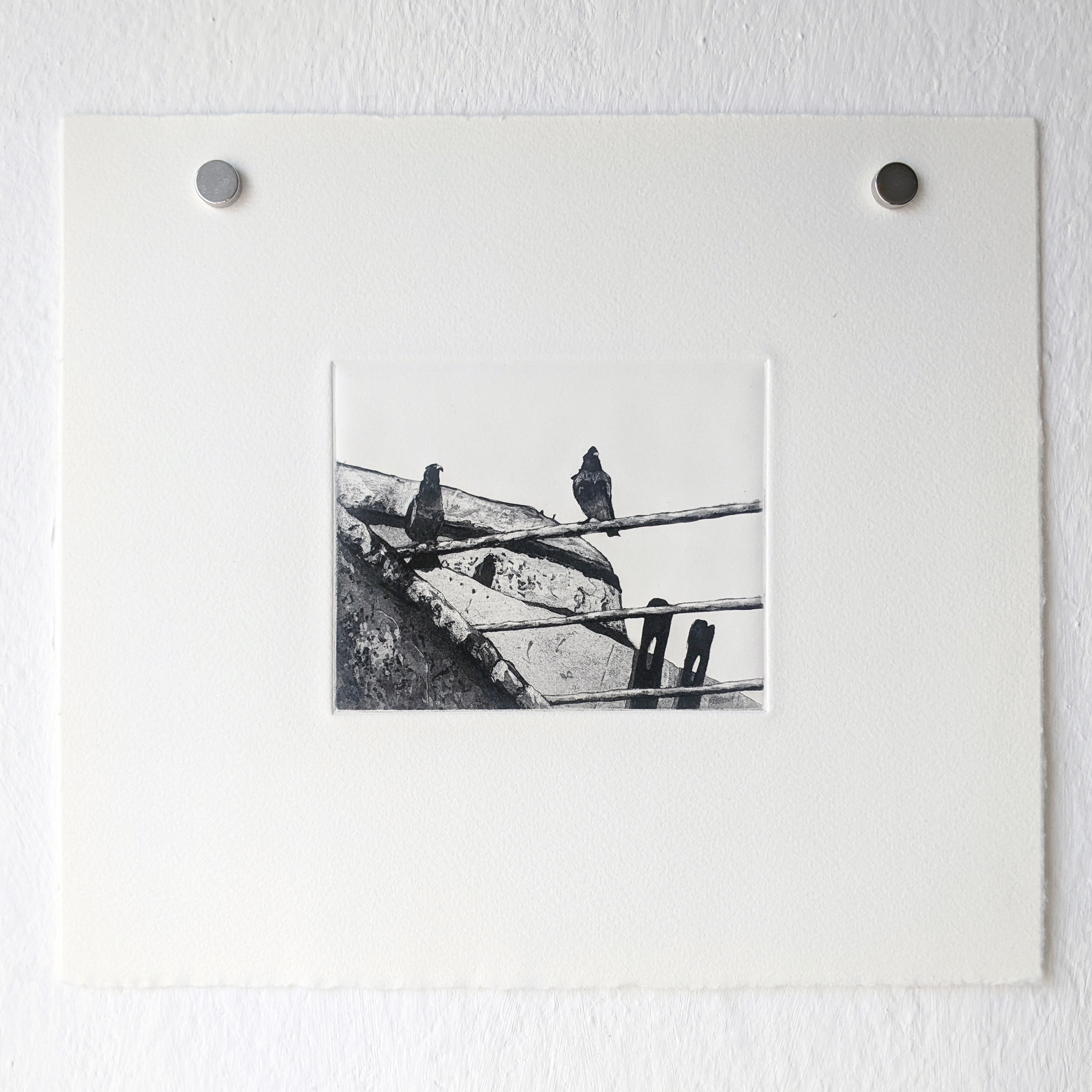
Woolwich Dockyard is a stretch of post-industrial riverside that used to be at the centre of Britain’s maritime operations. Each day, I pass slips and docks, gun batteries, clockworks, guard posts and timber yards. Between concrete slabs, wrought iron fencing and historic brickwork, nature blooms. It springs forth from between nooks and crannies, cracks and crevices. Poppies, daffodils, wild lavender, dandelions, daisies, cowslip, grasses, weeds, marsh, all jostling for position and reaching for the sun. Most days, there are more pigeons than people making use of the benches and public spaces.
This series is accompanied by other works on paper reflecting on nature and nurture, reality and reverie. All of the work is underpinned by my continued research into more sustainable practices in printmaking, using lower toxicity, more inclusive methods and materials.
—
The gallery itself is small and intimate so I will not be having a private view, but I will be there each weekend. Please get in touch if you would like to visit at another time, it would be lovely to see you all!
PS I had a massive wobble in June and July, so I stopped writing for a while to get my bearings back. I’m back, and you’ll be seeing and reading more on sustainable practice, and that wobble, soon.
How did you do that (most amazing printmaking thing)? Why did you choose do work this way? How much does this cost? Is there an alternative? Can I use less? Can I use more, better? What does it mean by “non-toxic” – to myself, to fish? In what quantities? Can I sustain this? Can I teach this? Can I scale this up?
Answer questions.
Be generous with knowledge. Holding information back does not make me a mysterious, enigmatic, printmaking wizard, it makes me greedy, selfish and privileged. Look it up, privilege is by definition a special advantage available only to a particular person or group. So what if it took me ten years to work out a closed-loop water system for etching? Do I want to put someone else through that: the potential waste of resources, of creative time, the potential loss of a fellow sustainable practitioner, when I could havejust shared when they asked.
Consider the before and after.
How was this made, how did it get here, where will it go once I’m done with it? This is tough. In some cases, materials and substances that are non-toxic to the user, may not have been so in its manufacture or its disposal. Likewise, repurposing items for use in printmaking may take them out of a recycling loop and actually add to waste. Further still is the possibility that the less ‘green’ choice might be longer lasting and therefore more sustainable in the broader sense. This is proper wormhole stuff, but I try to bear it in mind. I refer to Points 1 & 2.
Practice.
The first time I made a stone lithograph, it was a stone cold turd. It was nothing like anything I had done before, I’m not sure what I remember now, or if I even enjoyed it. What I did know was that artists whose work I admired had made beautiful prints this way, and I wanted to be one of them. It will get better with practice.
Remember that one size does not fit all.
It is very easy to judge others. I know I do it instinctly; it’s an impulse, a reflex. It is hard to stand back and remember that the choices I have made have been guided by resources and privileges that may differ for others. Money, time, space, concept, body, knowledge, matters when it comes to making choices.
I am going to give a complex example, which I will explore further in a later post. A printmaker who owns their studio, has weighed the safety and health issues of solvent-based, acid-based systems with which they already familiar, against the environmental issues of acrylic-based, salt-etch systems, which have their own issues in regards to dissolved plastics and waste disposal, and which would be completely new to them.
They consider frequency, cost, and access. They can afford to install good local exhaust ventilation and hazardous storage. They work alone, on small plates, and in short bursts due to family commitments. Which option is the most sustainable, financially, socially, environmentally? What if they asked me?
My response: I need more information, and a bit of both systems, probably. I would say that a decision taken today can be allowed to change incrementally over time. I would also say, my own conditions are different, so my solutions are different: I rent a studio, I sometimes work with others, I work very long hours (not meant as a boast, but to indicate potential length of exposure to a substance!).
Not very satisfying, is it? It would be so much easier if there was one right answer for everyone, but there isn’t, especially when technical processes are intimately linked to creativity and artistic expression.
Embrace change.
Printmaker is not about tradition, printmaking is about change.
Change does not have to be big, or fast, or expensive, or time consuming. It can start with a small pivot, a slight tilt.
Change can be incredibly positive. The work I make now is far more visually interesting and involving than anything I made in the past, because I think about sustainability at every stage. The work I make now is more rewarding, more challenging, more exhilarating, because I am less afraid to ask questions of it.
Change is necessary. I thought long and hard about including this, because it may come across as forceful, but so be it. We have a limited amount of time, space and resource on this earth, and if we want our practice to be sustainable, and for it to sustain future printmakers, we must change.
Give yourself permission.
To make prints. To be frustrated. To be delighted. To be confused. To make prints. To make bold choices. To change your practice. To look to the future. To make prints.
There are a great many examples of arts manifestos: some are lists of rules, others are slogans by which to live, and others still are essays, books, tomes through which artists and organisations express in words the principles of their practice.
When I started writing, I did not set out to write one. I set out to reflect closely on my printmaking practice, but also to step away from it, to find the ‘gist’ of it, especially as it relates to sustainability.
Answers are out there. What I’ve come to conclude is, however, they are not “use oil instead of solvents to clean up”, or “try water-based screen printing inks”, or even “ten steps to replace nitric with saline sulphate”.
These are helpful, practical steps that may suit some practices, in some situations. What I’m looking for is sustainable principles for sustainable printmaking. Principles that will apply regardless of process. I know how that sounds – after all, isn’t printmaking all process? I say no, printmaking is a lifestyle, a philosophy, a religion, a choice full of choices.
I am writing as a person who has chosen printmaking, or maybe printmaking chose me. I make and teach screenprinting, etching, relief, lithography, photographic plate and digital print processes. I have worked in small private studios, and large, publicly funded workshops based in higher education, or tied to cultural institutions. I’ve taught in spaces with no easy access to water, worked on projects with almost no budget, editioned other projects that seemed to have endless budget (just once, actually). In each and every situation, these principles can apply, and in many cases, were already being applied.
If this is useful to you, please have it. If it isn’t, I urge you to take ten minutes and write your own rules down. Find the ten minutes. Stare at the words and see if they reflect your practice back. Give yourself longer if you need it. My stars may not be yours.
Ask questions.
Answer questions.
Think about the before and after.
Practice.
Remember that one size does not fit all.
Embrace change.
Give yourself permission.
We can disagree, and still be friends.
Next post: what do these seven phrases actually mean?
The physical and psychological distance between the Mawddach Estuary in Wales, and my London life, provided a unique space for all sorts of reading.
Here is a list of everything I read, or am reading, some of which is referenced in the work I have written, and the drawings I have made. I wouldn’t go so far as to call it a proper, ‘annotated’ bibliography, but I have noted and commented where it felt appropriate.
Books
> Antreasian, G., and Adams, C. (1972) The Tamarind Book of Lithography: Art and Techniques. New York, Harry N. Abrams Inc.
No surprises here, except that I came all the way to Wales to borrow a book I’ve long had at home! Thank you to Scarlett Rebecca for the lend, it has been useful for inserting immediate references into some of my drafts.
> Cornell, A. (1959) Rape of the Fair Country. London, Hodder & Stoughton Ltd.
In progress, for the train ride home. Recommended to me by a printmaking colleague. A story of life in 19th century Wales, following a family whose lives are intrinsically linked to the politics of coal and iron.
> Griffith, A. (1980) Prints and Printmaking: An introduction to the history and techniques. London, British Museum Press.
An extremely dense summary of the history of western printmaking, from its early woodcut origins in the 13th century to the development and incorporation of photomechanical and colour printing techniques of the first half of the 20th century. Maybe not the most obvious or compelling read, but what Griffith demonstrates in 127 pages is the breadth, ingenuity, creativity and resourcefulness of printmaking and printmakers over its history.
Not staid, nor tied to tradition, nor shackled to technique, printmakers embraced continuous change in their materials, processes, subject matter, audience, and reception.
> Hatton, K. (Ed.) (2015) Towards an Inclusive Arts Education. London, Institute of Education Press.
There are ten papers that make up this volume, spanning topics such as critical race theory, student diversity, the art and design curriculum, and academic attainment. Together, they provide a dense, academic introduction to the intersectionality of inclusive arts pedagogy; the main challenges faced by those attempting to make changes; and the opportunities for creativity that arise when change is embraced.
> Ilyin, N.(2019) Writing for the Design Mind. London, Bloomsbury Publishing Plc.
In progress. A guide to writing well for designers and visual creatives, Ilyin sets up this book as a contract between the writer and reader: complete the exercises, use the whole time allotted for each exercise, become a better writer. I will admit, I have expedited the schedule somewhat, and am doing an exercise each day. I should leave the residency on Exercise 7, and aim to carry on in the studio.
> Kara, H. (2015) Creative Research Methods in the Social Sciences: a practical guide. Bristol, Policy Press.
A step-by-step flash tour of creative research methods, with a focus on the ‘creative’ aspect. Especially useful to read case studies of blended and mixed-methods research in practice, and how to approach analysing subsequent data. A considered section on ethics, with good examples of how decisions by distant committees can sometimes be to the detriment of research. Kara writes very clearly, and draws good distinctions between ‘creative’ and ‘innovative’ research.
> Kuang, R. F. (2018) The Poppy War. London, Harper Voyager. > Kuang, R. F. (2019) The Dragon Republic. London, Harper Voyager. > Kuang, R. F. (2020) The Burning God. London, Harper Voyager.
I started this trilogy the week before my journey up to Wales, and raced through it in my time here. Providing sharp contrast to the academic and non-fiction reading, this fast-paced trilogy quickly became my meal time and evening entertainment. They haven’t directly influenced my own writing, but I have enjoyed that the are written from the perspective of a young, Asian, female warrior and soldier.
> Webb, B. And Skipwith, P. (2015) Eric Ravilious: Design. Woodbridge, ACC Art Books Ltd.
I have long been a fan of Ravilious’s famous submariner series of lithographs: ten illustrations of an idyllic life on a WW2 boat, half sublime fantasy, half darkness underwater. This, however, was my first encounter of his work as a student, an engraver, a typographer, a designer. The range of his output is remarkable, his compositional style distinct.
Journals
> Coe, J. (ed.) (2017) Pressing Matters, Issue 01, 1-88 > Coe, J. (ed.) (2017) Pressing Matters, Issue 02, 1-88 > Coe, J. (ed.) (2017) Pressing Matters, Issue 04, 1-88 > Coe, J. (ed.) (2018) Pressing Matters, Issue 05, 1-88 > Coe, J. (ed.) (2018) Pressing Matters, Issue 06, 1-88
I must admit, and it seems rather unbelievable, but I have never read a whole issue of John Coe’s Pressing Matters. It is often around, on the shelves of studios, the desks of colleagues and peers, sometimes the most recent version makes an appearance in the workshop kitchen.
I am lucky the first issues are among the books and journals available at the residency, and I can take time to catch up. These journals are a time travel device to a not-very-distant past, a welcome revisiting of friends, workshops, exhibitions, materials research. They are also an introduction to new idea, new spaces, new printmakers. Highlights from Issue 06 – Educate and Empower: an introduction to the US-based collective Black Women in Print (p23, Issue 06); Making Paper: St. Cuthbert’s Mill in Somerset (p52, Issue 06).
Reading these volumes back to back provided insight into the styles, formats, voices and writing strategies used by printmakers, for printmakers.
If anyone has Issue 3 and wouldn’t mind lending it to me, please get in touch!
Part of Panic! It’s an arts emergency project, and funded by AHRC, this report was referenced in the a-n inquiry below. Written before the COVID-19 pandemic, it illustrates the already prevalent fallacy of meritocracy in the arts, and the widespread culture of unpaid labour. While taking gender and ethnicity into consideration, the focus of this report is on social class, social mobility, and the complex picture of representation in the arts over the last thirty years.
Referred to in the a-n inquiry below, this blog entry is a vivid account of the first COVID lockdown as experienced by artists, which exposed and exacerbated the precariousness and vulnerability of the arts sector in the UK. Giles draws a useful distinction between the rise in our consumption of artistic media at the time, and of artists being paid or finding ways to be paid for their continued output.
> Lazard, C. (2019) Accessibility in the Arts: a Promise and a Practice. Available at: https://promiseandpractice.art/ [accessed 01 May 2023]
A compact guide on accessibility and practical accommodations for a range of arts-based scenarios. Based on the social model, distilled into specific steps that can be adapted by small-to-medium arts organisations, it is quite an overwhelming read when taken in one sitting. Lazard moves swiftly through everything from air quality to lighting to sliding scales and economic justice, when any one of these topics might have taken up the whole 36 pages of this downloadable PDF. While most guidance is sensible and useful, I wonder how practicable or effective a ‘fragrance-free’ policy is, for example. Evidence-based risk assessments that demonstrated the requirement and effectiveness such specific control measures would be useful.
Commissioned by a-n The Artists Newsletter Company, this is a sobering but sadly unsurprising summary of the precarious working conditions in which artists find themselves. This inquiry digs deeply into institutional abuses of artists as free and unacknowledged labour, especially where artwork is uncoupled from labour. Even acknowledging the self-selecting bias of data sets gathered through voluntary and anonymous surveys, that any artists should find themselves working to low- or no-pay terms and that this experience is so widespread are both a warning to those considering a career in the arts, and a call to action by those already in it.
This will be the last post about the residency itself; tomorrow I will post a loosely annotated bibliography. On Friday, I will begin a series of weekly posts on sustainable printmaking, of which I now have several drafted.
The waters of the Mawddach estuary are shallow, the tides dramatic, drawing in and pulling away each day across vast expanses of sand, marking the passage of time. Time is both slow and quick here, water lapping on the shore a steady shhh-, shhh-, shhh-, wildflowers blooming with each passing day, set against a landscape of mountains that mark change in centuries and millennia.
That is how time has acted on my body and mind here, a contrast of fast and slow. Intense, brief, moments of running, drawing, reading, writing, set against a life’s commitment to printmaking as a vehicle for sustainable making and social justice.
I return to London on Friday, but my mind has already started to drift south and east, ready to carry on.
Me, modelling for Draw Brighton, from North Wales.
A lot of people have asked why I go on residencies, especially when I have access to terrific facilities and a studio where I live.
It is, for me, a chance to focus on a particular aspect of practice, but in a new environment, surrounded by new people and opportunities. Asking a question, in an unfamiliar setting, throws up different perspectives. The ephemera or clutter surrounding that question fades away with time, focus and distance, and answers rise gently to the surface.
Without the regular clutter of London life, the days also seem to have more hours, which is useful when you’re trying to work, read, or write meaningfully.
That being said, last night I put away the books and spent an hour in the hot seat as a model for the Draw Brighton online programme. You read it correctly: model. Queue surprise face! Hosted by Jake Spicer, this online session was attended by more than 50 participants, and I was touched and impressed by the drawings they produced and subsequently shared.
A big ‘thank you’ to Marigold Plunkett, here on residency with me, who convinced me to say yes to the session, and has also encouraged me slowly back into the practice of drawing.










 inkedtwice